
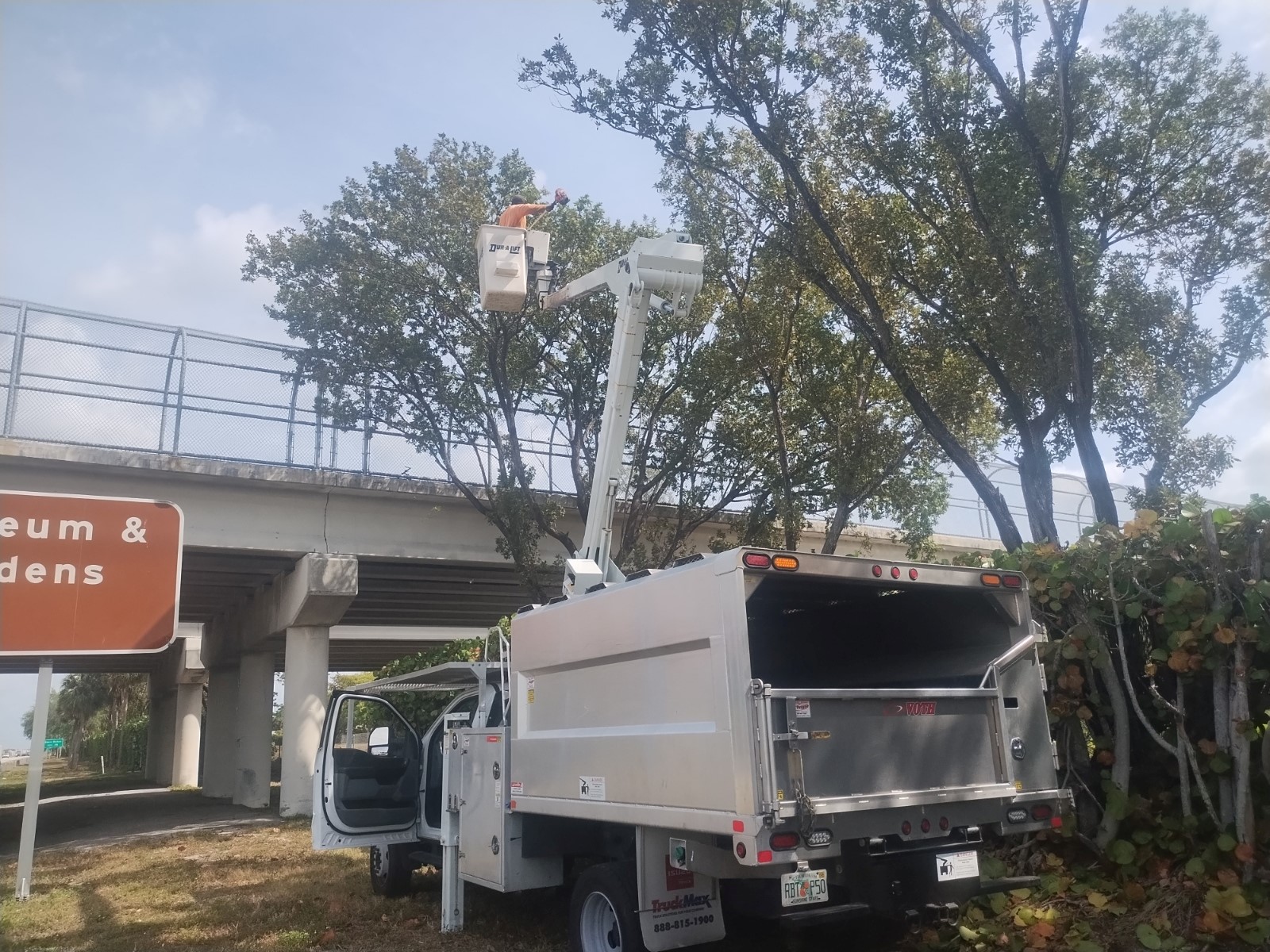
Hurricane season runs from June 1 to November 30, and the busiest stretch for South Florida falls between mid-August and late October. If you are reading this in the middle of that window and your trees have not been touched since last year, you are not too late — but the work you do now is different from the work you would have done in May.
Here is how tree trimming actually reduces storm risk, when it should happen, and what to do if a storm is already being tracked.
The Goal Is Wind Passing Through, Not a Shorter Tree
The most common misunderstanding about storm trimming is that a smaller tree is a safer tree. It is not. What makes a tree dangerous in high wind is a dense, sail-like canopy that catches wind instead of letting it through, combined with dead or weakly attached limbs that break away.
Proper hurricane preparation thins the canopy so air moves through it. A correctly thinned tree looks largely the same from the street — same height, same shape — but light reaches the ground through it and the branch structure is visibly cleaner.
Why Topping Makes Trees More Dangerous
Every year in South Florida, crews go door to door before a storm offering to cut trees down to stubs. This practice, called topping or hat-racking, is one of the worst things you can do to a mature tree.
Cutting a tree back to bare limbs forces it to push out fast, weak regrowth from the cut points. Those new shoots are attached to the outside of the old wood rather than anchored in it. Within two or three seasons you have a tree that is denser than before and covered in branches that snap off easily — the exact opposite of what you wanted. Many South Florida municipalities also restrict or prohibit the practice, and it can reduce the value of a mature specimen permanently.
If a company quotes you a very low price to "cut it way back before the storm," that is usually what you are buying.
The Trees That Cause the Most Damage Here
Not every tree presents the same risk. In Miami-Dade, Broward and Palm Beach, the recurring problems are:
- Ficus — fast growing, heavy, shallow rooted, and prone to going over whole in saturated soil.
- Black olive and mahogany — dense canopies that catch wind badly when they have not been thinned.
- Australian pine and melaleuca — brittle invasives that shed large limbs and often sit along canal banks and property lines.
- Coconut and royal palms — the trunk usually survives, but dead fronds and seed pods become projectiles.
- Anything leaning over a roof, pool cage or seawall — regardless of species, that is where damage gets expensive.
The Right Timing
The ideal window for storm preparation is late winter through May, before the season opens. Trees have time to seal their cuts and settle before the first serious wind, and crews are not booked solid.
Mid-season trimming is still worthwhile, particularly for removing deadwood, clearing limbs off structures and taking down obviously compromised trees. What we avoid in August and September is heavy structural pruning — a tree that has just had a large amount of live growth removed is stressed, and stress is not what you want going into a storm.
The one thing that is always worth doing, at any point in the season, is removing what is already dead. Deadwood does not become safer by waiting.
When a Storm Is Already Being Tracked
Once a named system is in the forecast cone, the calculation changes. Crews book out within a day or two, and debris left at the curb becomes a hazard in itself — municipal pickup stops well before landfall, and loose piles turn into airborne material.
At that stage, focus on what can be done and cleared quickly: dead fronds, hanging limbs, anything already broken, and loose yard material. Save the larger structural work for after the season.
Palms Need Different Attention
Palms handle wind better than most broadleaf trees, and a healthy palm will usually bend and recover. The hazard is what it is carrying. Dead fronds and heavy seed pods come loose at speed, and coconuts in particular do real damage to windows, screens and vehicles.
Cleaning a palm before the season is quick work. Over-stripping it is not helpful — removing green fronds weakens the palm and offers no storm benefit. Take the dead material and the pods, leave the living crown alone.
After the Storm
Post-storm work is its own job, and we have covered it separately in what to do after a storm: downed trees across driveways and fences, hangers left in canopies, blocked canals and drainage easements, and debris that has to be cut, chipped and hauled. Document damage with photographs before anything is moved if you intend to file an insurance claim.
We handle storm response across Miami-Dade, Broward and Palm Beach County, including commercial properties and HOAs that need multiple sites cleared quickly.
Book Before the Season, Not During It
The properties that come through storms well are almost always the ones trimmed on a schedule rather than in a panic. If your trees have not been assessed this year, it is worth having someone look at them now — even if the recommendation is to wait until winter for the heavy work.
Marciano Landscaping provides tree trimming and removal throughout South Florida. Call (786) 560-1827 for an assessment.
Leave a Reply