
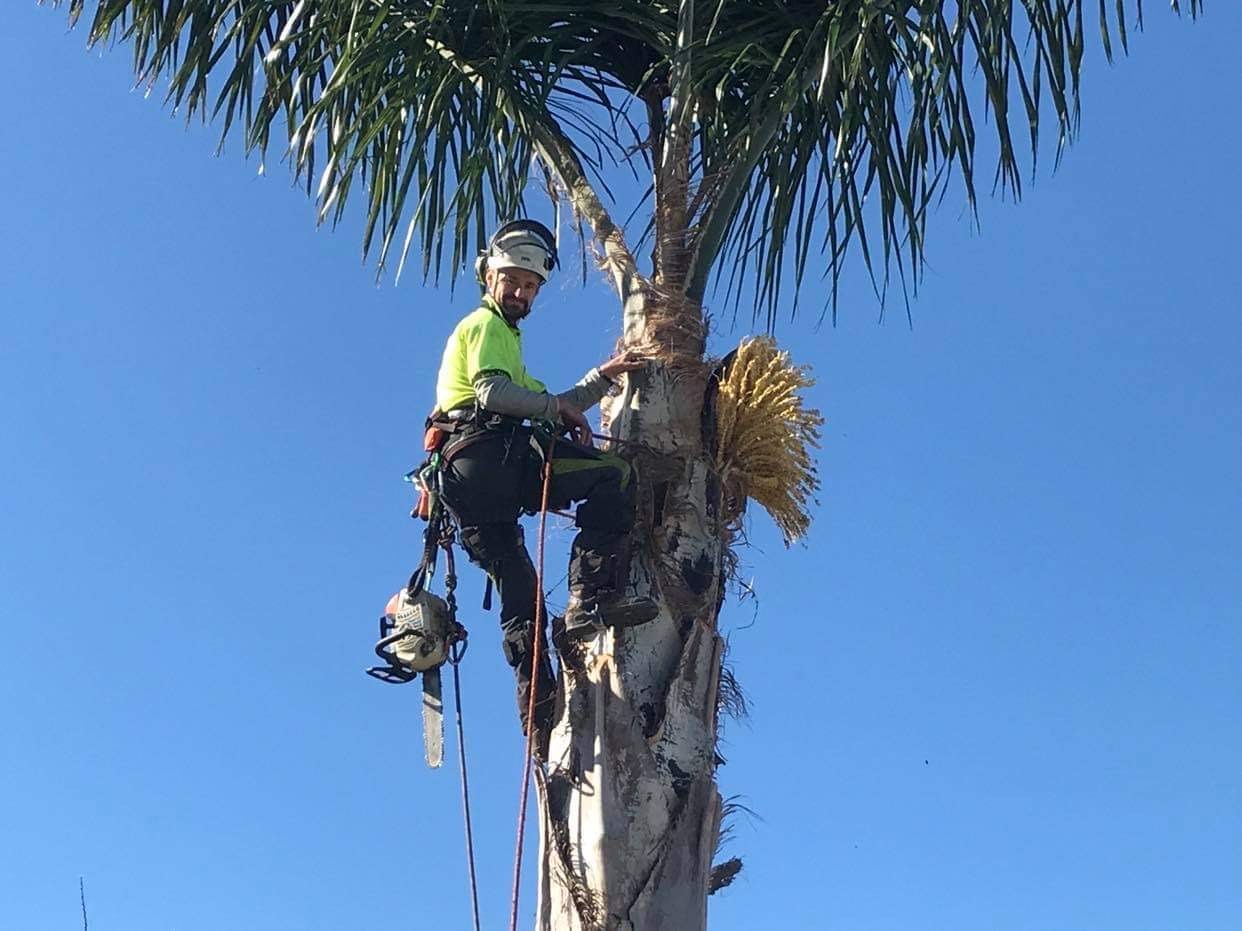
Palms are the most commonly mistreated plants in South Florida landscaping. They are also the most visible — a badly cut palm stays badly cut for years, because unlike a shade tree it cannot grow new branches to cover the damage.
Here is how often palms actually need attention, how much should come off, and why the most popular cut in Florida is the one to avoid.
Once a Year Is Usually Enough
Most palms in a residential setting need cleaning once a year. Some, like coconut palms carrying heavy fruit, do better on a twice-yearly schedule — not because the fronds need it, but because the pods do.
The trigger for trimming is not the calendar. It is whether the palm is carrying material that is dead, dying, or dangerous:
- Fronds that have gone fully brown and are hanging down against the trunk
- Seed pods and fruit, particularly coconuts over a driveway, walkway or parking area
- Old flower stalks
- Loose boots on species that hold them
If none of that is present, the palm does not need cutting. A palm with a full green crown and nothing dead in it is a healthy palm, not a neglected one.
The Hurricane Cut Is Not Hurricane Preparation
The most requested palm trim in South Florida goes by several names — hurricane cut, pineapple cut, or simply "taking it way back." It means stripping the crown down to a handful of upright fronds, leaving the palm looking like a feather duster.
It does not reduce storm damage. Palms survive wind through flexibility, and the trunk is what has to hold. What the cut does do is remove the palm's working leaf area, which is where it makes the energy it needs to push out new growth.
The consequences show up over the following year or two:
- Narrowed, weakened new growth at the top of the trunk, sometimes called pencil-pointing
- Slower recovery and thinner crowns each cycle
- Greater vulnerability to nutrient deficiency, which is already common in our soils
- Open wounds higher up the trunk that invite pests and disease
A palm that has been over-cut repeatedly will eventually fail at the crown, and at that point the only option is removal.
The Rule of Thumb: Nothing Above Horizontal
The standard guidance among arborists is straightforward. Picture a clock face with the trunk at the center. Remove fronds hanging below the nine-and-three line — the ones that are dead, dying or drooping. Leave everything above it.
Green fronds growing upward and outward are doing work for the palm. Cutting them buys nothing and costs the palm real energy. If a crew is removing healthy green fronds from the upper crown, they are damaging the plant, whatever the job is called on the invoice.
Species Behave Differently
Coconut palms are the ones that most often need a second visit. The nuts are heavy, they fall without warning, and they cause more property damage in South Florida than the fronds do. If a coconut palm overhangs anything you care about, keeping the pods cleared matters more than the fronds.
Royal palms largely maintain themselves. Their fronds are enormous and detach cleanly on their own, which is precisely the problem — a royal palm frond can weigh a great deal and falls without warning. The work is timing the removal rather than shaping the crown.
Queen palms shed constantly and produce heavy fruit clusters that stain driveways and attract pests. They tend to need attention more often than owners expect.
Sabal palms, the Florida state tree, can be left with their boots or cleaned to a smooth trunk. That is an aesthetic decision, not a health one.
Why Dead Fronds Are a Fire Risk Too
Storm damage gets the attention, but a skirt of dry brown fronds against a trunk is also fuel, and it sits directly against a structure in a lot of South Florida landscaping. In dry stretches, palms close to buildings, fences and pool enclosures are worth clearing for that reason alone.
Dead fronds also make good habitat for rats and wasps, which is usually the argument that convinces people faster than either fire or wind.
What Good Palm Work Looks Like
A properly trimmed palm should look almost untouched from across the street. The crown is full, the trunk is clean, there is nothing brown hanging, and there are no pods where they can fall on anything. Cuts are made close to the trunk without gouging it, and climbing spikes are not used on a palm that is going to stay in the ground — the puncture wounds do not heal.
All material should leave with the crew. Fronds and pods left in a pile are a hazard of their own.
Booking Palm Work
The best time for palm cleaning in South Florida is spring, before the season. Coconut pod clearing is worth doing whenever the fruit is heavy, regardless of the month.
Marciano Landscaping handles palm trimming, frond and pod removal, and full tree trimming and removal across Miami-Dade, Broward and Palm Beach County. Call (786) 560-1827 for a price on your property.
Leave a Reply