
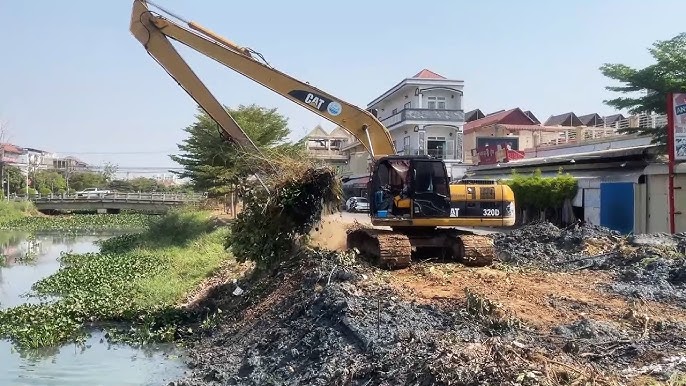
Canal and lake banks are the line item that HOA boards in South Florida underestimate most consistently. The work is invisible when it is being done properly and extremely visible when it is not — usually at the worst possible moment, which is the first heavy rain after a season of deferral.
Here is what waterway maintenance actually involves in Miami-Dade, Broward and Palm Beach, what drives the cost, and why the deferred version is more expensive than the scheduled one.
What the Work Covers
Canal maintenance is not one task. On a typical community it includes:
- Bank clearing and trimming — keeping the slope accessible and free of encroaching growth
- Invasive vegetation removal — Brazilian pepper, melaleuca and Australian pine in particular
- Mid-channel harvesting — removing floating and rooted aquatic growth that restricts flow
- Debris removal — storm material, dumped items, fallen limbs
- Hauling — everything cut has to leave the property
The last point is where quotes diverge most. A price that looks low is often a price that leaves the cut material on the bank, which means it washes back into the channel with the next storm.
Two to Four Visits a Year, Not One
Subtropical growth rates are the reason annual service does not hold here. Vegetation that would take three years to become a problem further north does it in one wet season.
Most communities need service two to four times a year. Quarterly is the pattern that works for the majority — enough to stay ahead of growth, spaced so that each visit is routine rather than a recovery job.
Communities that move to annual service to save money almost always end up paying more per visit, because each visit becomes a clearing project instead of maintenance.
The Invasives Problem Is Specific to Us
Brazilian pepper, melaleuca and Australian pine are all listed invasives in Florida, and all three colonize canal banks aggressively. They matter for practical reasons beyond the regulatory ones:
- They establish faster than anything native and shade out bank stabilizing growth
- Australian pine is brittle and drops large limbs into the channel during storms
- Melaleuca spreads readily after disturbance, so a partial job makes the problem worse
- Root systems undermine bank structure over time, which turns a vegetation issue into an erosion issue
Removal has to be thorough to be worth doing. Cutting the visible growth and leaving the root systems produces denser regrowth within a season.
What Drives the Price
When boards compare bids and the numbers are far apart, the difference is usually one of these:
- Linear footage of bank — the primary driver
- Access — whether equipment can reach the bank, or whether the work has to be done by hand from a narrow easement
- Slope and condition — steep or eroded banks are slower and require more care
- How long since the last service — a first visit on a neglected canal is a clearing job, not a maintenance visit, and should be priced separately
- Whether hauling is included — the item most often left out of a low bid
- Aquatic work — mid-channel harvesting is a separate operation from bank work
A useful question when comparing proposals is simply whether the first visit is priced the same as subsequent ones. If it is, the contractor may not have looked at the site.
Budgeting It Properly
Two things make waterway maintenance easier to defend at budget time.
The first is separating restoration from maintenance. If a community has deferred for several years, the catch-up work is a capital item — a one-off cost to bring the banks back to a maintainable condition. The recurring line item after that is much smaller, and presenting them as one number makes the ongoing cost look far worse than it is.
The second is scheduling around the wet season. Growth accelerates from roughly May through October. A community on quarterly service benefits from having visits fall before and after that stretch rather than at arbitrary intervals.
What Deferral Actually Costs
Restricted channels do not drain at capacity, and in South Florida the consequence of a channel that does not drain is water where residents can see it. Beyond flooding, deferred banks bring erosion that eventually requires regrading, resident complaints that arrive faster than board meetings, and in some communities obligations to the local drainage or water control district that are easier to meet continuously than retroactively.
None of those are dramatic in any single quarter. They compound.
Working With a Contractor
For HOAs and property managers, the things worth confirming before signing are straightforward: that the contractor is licensed and insured, that a certificate of insurance is available for your files, that hauling is included in writing, and that someone will walk the site before quoting rather than pricing from a map.
Marciano Landscaping provides canal cleaning and waterway maintenance and scheduled commercial and HOA grounds maintenance across Miami-Dade, Broward and Palm Beach County. Call (786) 560-1827 to arrange a site visit and a written proposal.